Refinancing at 5.85%? Cut $340 Off Your Mortgage Now
Anúncios
Could lowering your monthly housing bill by hundreds of dollars be simpler than you think? Refinancing at 5.85% is catching the attention of U.S. homeowners eager to shave up to $340 off their monthly payments.
Locking in a lower mortgage rate can free up substantial cash flow, yet upfront closing costs and break-even timelines determine whether the move truly pays off. A quick look at the numbers separates genuine long-term savings from short-term illusions.
We break down the exact loan math behind securing a more affordable home loan payment. Discover what rates, fees, and market shifts to evaluate before submitting your application.
The Current Mortgage Landscape and 5.85% Rate
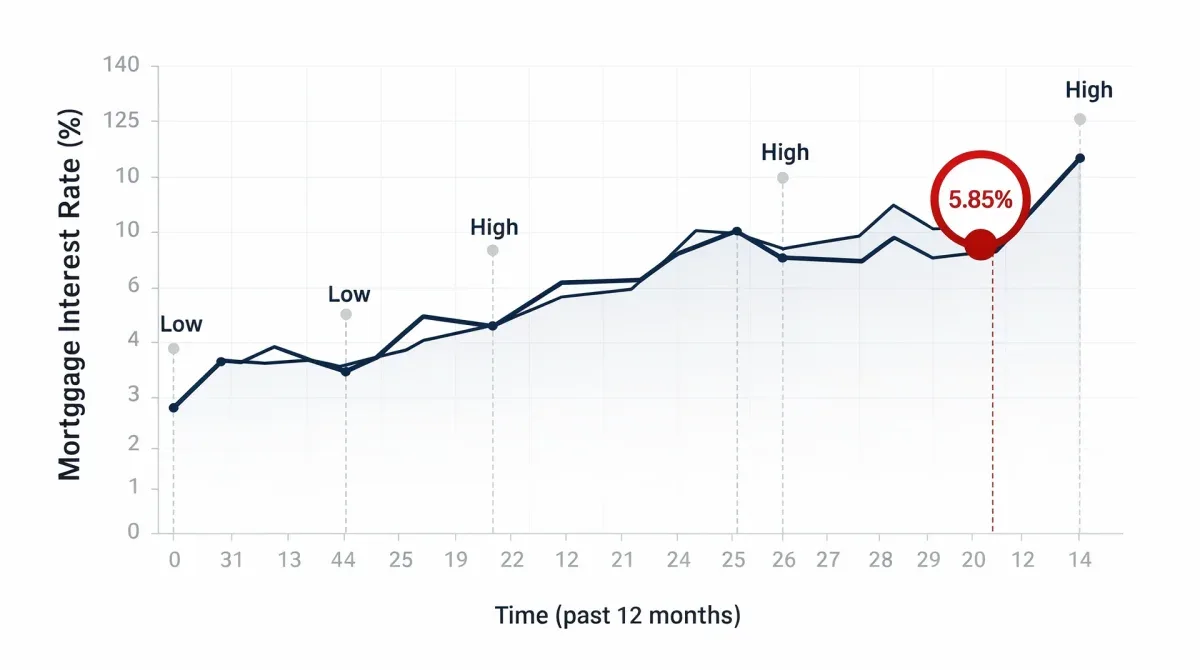
The housing market has seen considerable shifts, with interest rates experiencing periods of volatility. A 5.85% rate, while not historically low, represents a significant improvement for many homeowners who secured mortgages during higher rate environments.
This particular rate has emerged as a focal point for those looking to reduce their monthly expenditures. The question of whether Is Refinancing at 5.85% Worth It? is a complex one, requiring careful consideration of personal financial situations.
Anúncios
Economic indicators and Federal Reserve policies continue to influence mortgage rates. Analysts suggest that while rates could still move, 5.85% offers a compelling benchmark for potential savings and long-term financial stability.
Analyzing Your Existing Mortgage Terms
Before considering a refinance, it is crucial to review your current mortgage's interest rate, remaining balance, and term. This baseline information will be the foundation for any comparison and calculation of potential savings.
Understanding the principal and interest portion of your existing payment is key to seeing where savings can be generated. Many homeowners may find their current rates are significantly higher, making the 5.85% offer quite attractive.
Identify your current mortgage interest rate.
Determine your outstanding loan balance.
Note the remaining term of your mortgage.
The difference between your current rate and 5.85% is the primary driver of potential savings. A substantial spread often justifies the costs associated with refinancing, especially when looking to cut $340 off your monthly payment.
The Exact Math to Cut $340 Off Your Monthly Mortgage Payment
To truly understand if Is Refinancing at 5.85% Worth It?, we must break down the numbers. The potential savings are not just about the interest rate reduction but also the new loan term and any associated fees.
Let's assume a homeowner has an outstanding mortgage balance of $300,000 with a current interest rate of 7.0% on a 30-year fixed loan. Their current monthly principal and interest payment would be approximately $1,996.
If this homeowner refinances to a 5.85% interest rate on a new 30-year fixed loan, their new monthly principal and interest payment would drop to approximately $1,656. This represents a monthly saving of exactly $340.
Anúncios
Calculating Your Potential Savings
The calculation is straightforward: compare your current monthly principal and interest payment with the projected payment at 5.85%. This difference is your immediate monthly saving.
However, it is important to factor in closing costs, which can range from 2% to 5% of the loan amount. These costs can either be paid upfront or rolled into the new loan, affecting the total amount borrowed and thus the overall interest paid.
Compare current payment vs. new payment at 5.85%.
Calculate total closing costs for the refinance.
Determine the breakeven point considering closing costs.
The breakeven point is crucial: how long will it take for your monthly savings to offset the closing costs? If you plan to stay in your home beyond this point, refinancing at 5.85% could be highly beneficial.
Factors Beyond the Rate: Fees and Closing Costs
While the 5.85% interest rate is attractive, the decision to refinance is not solely based on this number. Closing costs, including appraisal fees, title insurance, origination fees, and other charges, play a significant role in the overall financial picture.
These costs can add up, potentially diminishing the immediate impact of a lower interest rate. It is essential to receive a detailed breakdown of all fees from prospective lenders to accurately assess the total cost of refinancing.
Understanding how these fees are structured and whether they can be negotiated is part of the due diligence process. Some lenders may offer "no-closing-cost" refinances, but these often come with a slightly higher interest rate, effectively rolling the costs into the loan.
Understanding the Breakeven Point
The breakeven point is the duration it takes for your monthly savings to equal the total closing costs. For example, if closing costs are $6,000 and you save $340 per month, your breakeven point is approximately 17.6 months ($6,000 / $340).
If you plan to sell your home before reaching this breakeven point, refinancing might not be the most financially prudent decision. Conversely, staying in your home for several years beyond the breakeven point maximizes your savings.
Calculate total closing costs for the refinance.
Divide total closing costs by your monthly savings.
Assess your long-term housing plans relative to the breakeven point.
Evaluating the breakeven point helps determine the long-term viability and financial benefit of pursuing a refinance at 5.85%. This metric provides a clear timeline for when the refinance truly becomes profitable.
Long-Term Financial Goals and Refinancing
The decision of Is Refinancing at 5.85% Worth It? should align with your broader financial objectives. Refinancing can do more than just lower your monthly payment; it can also help you achieve other goals.
For instance, some homeowners might opt for a shorter loan term to pay off their mortgage faster, even if it means a slightly higher monthly payment than the maximum possible savings. Others might use the savings to pay down other high-interest debt.
Considering the long-term implications, such as total interest paid over the life of the loan, is crucial. A lower interest rate at 5.85% can significantly reduce the overall cost of borrowing, freeing up capital for other investments or savings.
Impact on Overall Wealth Building
Reducing your monthly mortgage payment by $340 can free up substantial cash flow. This extra money can be directed towards retirement savings, college funds, or other investment opportunities, accelerating your wealth-building efforts.
Furthermore, a lower interest rate means more of your monthly payment goes towards the principal, building equity faster. This accelerated equity growth enhances your overall financial position.
Allocate monthly savings to high-priority financial goals.
Consider a shorter loan term to pay off debt faster.
Evaluate the long-term impact on total interest paid.
Aligning your refinancing decision with your long-term financial strategy ensures that you are making a move that supports your future financial well-being, beyond just immediate savings.
Market Outlook and Future Rate Movements
The current economic climate suggests that while rates at 5.85% are favorable for many, future movements are always a possibility. Federal Reserve announcements and global economic trends continue to influence the mortgage market.
Expert opinions are divided on whether rates will trend significantly lower or higher in the near future. This uncertainty adds another layer to the question of whether Is Refinancing at 5.85% Worth It? now.
Monitoring economic forecasts and staying informed about market predictions can help homeowners make a timely decision. Locking in a favorable rate now could protect against potential rate increases later.
When to Act: Timing Your Refinance
Timing is a critical component of any refinancing decision. If current rates are significantly lower than your existing rate, and you plan to stay in your home past the breakeven point, acting sooner rather than later might be beneficial.
Waiting for potentially lower rates carries the risk that rates could also increase, making your current opportunity less appealing. It's a balance between seizing the present advantage and speculating on future market conditions.
Monitor economic forecasts and Fed announcements.
Assess the risk of waiting versus locking in a current rate.
Consult with multiple lenders for competitive offers.
The decision to refinance at 5.85% should be a well-informed one, considering both current benefits and potential future market shifts. This proactive approach ensures you capitalize on favorable conditions.

Comparing Lenders and Loan Programs
Not all lenders offer the same rates or terms, even for a 5.85% refinance. It is imperative to shop around and compare offers from multiple financial institutions to ensure you secure the best possible deal.
Different lenders may have varying closing costs, underwriting processes, and customer service levels. A thorough comparison can uncover not only better rates but also more favorable terms and conditions for your refinance.
Beyond the interest rate, examine the specific loan programs available. Some lenders might offer unique features or incentives that could further enhance the benefits of refinancing at 5.85%.
Key Considerations When Choosing a Lender
Look for transparency in fee structures and clear communication throughout the application process. A reputable lender will provide a detailed loan estimate, allowing you to compare apples to apples.
Consider their reputation and customer reviews. A smooth refinancing experience can be as important as the financial savings, especially during a significant financial transaction.
Obtain loan estimates from at least three different lenders.
Compare interest rates, closing costs, and lender fees.
Read customer reviews and assess lender reputation.
A diligent comparison of lenders and loan programs ensures that you maximize the benefits of refinancing and truly cut $340 off your monthly mortgage payment while avoiding unexpected pitfalls.
The Application Process and Required Documentation
Once you decide that Is Refinancing at 5.85% Worth It?, the next step is navigating the application process. This typically involves submitting various financial documents to your chosen lender.
Be prepared to provide proof of income, asset statements, and details about your current mortgage. A well-organized submission of documents can significantly expedite the approval process.
Lenders will review your credit history, debt-to-income ratio, and loan-to-value ratio to determine your eligibility and the terms they can offer. A strong financial profile generally leads to better rates and conditions.
Streamlining Your Refinance Application
Gathering all necessary documents in advance can prevent delays. This includes recent pay stubs, tax returns, bank statements, and your current mortgage statement.
Being responsive to additional requests from your lender will also help move the process along efficiently. Proactive communication can save time and reduce stress during what can be a complex procedure.
Prepare all financial documents in advance.
Be responsive to lender requests for additional information.
Ensure your credit score is in good standing.
A smooth application process helps ensure that you can quickly capitalize on the 5.85% interest rate and begin enjoying the $340 monthly savings from your mortgage refinance.
Potential Risks and Downsides of Refinancing
While the benefits of refinancing at 5.85% can be substantial, it is also important to acknowledge potential risks and downsides. Refinancing is a significant financial commitment, and not every situation warrants it.
One primary risk is extending your loan term. If you refinance a 20-year-old, 30-year mortgage back into a new 30-year mortgage, you effectively reset your repayment clock, potentially paying more interest over the very long run, despite lower monthly payments.
Another downside can be the accumulation of closing costs, especially if you roll them into the new loan. This increases your principal balance, meaning you're paying interest on those fees for the life of the loan. This can diminish the overall financial benefit if not carefully managed.
When Refinancing Might Not Be the Best Option
If your current interest rate is already low, very close to 5.85%, or if you have a short time left on your existing mortgage, the costs of refinancing might outweigh the benefits. The savings might not be significant enough to justify the effort and expense.
Homeowners with unstable financial situations or those planning to move in the near future should also reconsider. The breakeven point might not be reached before a sale, resulting in a net loss from the refinancing transaction.
Avoid extending your loan term if you are close to paying off your mortgage.
Be cautious if closing costs are excessively high relative to savings.
Do not refinance if you plan to move before the breakeven point.
A thorough assessment of these risks is crucial to make an informed decision. The question of Is Refinancing at 5.85% Worth It? is highly individual and depends on numerous personal factors.
Key Point | Brief Description |
|---|---|
Monthly Savings | Potentially save $340 monthly by refinancing to 5.85%. |
Breakeven Analysis | Calculate how long savings take to offset closing costs. |
Market Timing | Consider current rates versus future market predictions. |
Lender Comparison | Shop multiple lenders for best rates and terms. |
Frequently Asked Questions About Refinancing at 5.85%
What factors should I consider before refinancing at 5.85%?▼
Key factors include your current interest rate, remaining loan term, credit score, and financial stability. Additionally, evaluate closing costs and calculate your breakeven point to ensure the savings justify the expense, making sure Is Refinancing at 5.85% Worth It? is valid for your situation.
How do I calculate if I can save $340 off my monthly mortgage payment?▼
Compare your current principal and interest payment with the projected payment at a 5.85% interest rate on your outstanding balance. For example, a $300,000 loan at 7.0% vs. 5.85% on a 30-year term shows a reduction of $340, demonstrating how Is Refinancing at 5.85% Worth It?.
What are typical closing costs for a mortgage refinance?▼
Closing costs typically range from 2% to 5% of the loan amount and include fees for appraisal, title insurance, and loan origination. These costs can impact the overall benefit of refinancing, so understanding them is crucial before deciding if Is Refinancing at 5.85% Worth It? .
Should I roll closing costs into my new 5.85% mortgage?▼
Rolling closing costs into your new mortgage increases your principal balance, meaning you'll pay interest on those fees over the life of the loan. While it reduces upfront expenses, it can slightly diminish your long-term savings from the 5.85% rate and affect whether Is Refinancing at 5.85% Worth It? remains as impactful.
How does refinancing at 5.85% impact my credit score?▼
Refinancing involves a hard credit inquiry, which can temporarily lower your score by a few points. However, consistently making on-time payments on your new, potentially lower mortgage payment at 5.85% can improve your credit score over time, outweighing the initial dip, thereby supporting the decision if Is Refinancing at 5.85% Worth It?.
What this means
The current opportunity to refinance at 5.85% offers substantial potential for homeowners to optimize their financial situation. Understanding the exact math to cut $340 off your monthly mortgage payment requires a comprehensive review of your current loan, closing costs, and long-term financial goals.
Future market movements remain uncertain, making a timely and informed decision critical for those asking Is Refinancing at 5.85% Worth It?. By comparing lenders and diligently preparing for the application, homeowners can effectively reduce their monthly burden and strengthen their financial future.